
CodeLab RSI — RL-Governed Program Improvement
CodeLab RSI — RL-Governed Program Improvement
A reproducible Colab T4 experiment in learning how to select successive executable code edits.
Run in Google Colab · Notebook source · Full experimental report · Technical blog
Scientific question
Do DQN target networks, Double DQN, or dueling+Double DQN with an exponential-moving-average target help a controller choose sequential code-optimization edits that actually pass correctness tests and run faster on unseen input shapes?
What really executes
- Workload: exact Euclidean k-nearest-neighbor indices on deterministic generated arrays.
- Code space: distance computation by broadcast subtraction, GEMM identity, or chunked GEMM;
argsortvsargpartition; float32 or float64; two chunk sizes (24 finite combinations; some chunk choices are semantically identical for non-chunked kernels). - Correctness: candidate output must match independent double-precision brute-force neighbors; fail closed on exceptions or mismatched indices.
- Feedback: real CPU NumPy latency measured three times and cached by program/workload before training. A controller proposes an edit, receives log latency improvement, accepts faster edits and rejects slower ones; transitions form a five-step code-edit trajectory.
- Learned controller: PyTorch DQN trained on Colab’s Tesla T4 with a replay buffer. The CPU runs the algorithm benchmarks; the GPU trains neural controllers.
- Generalization: train using four calibration input shapes and freeze weights before testing on three distinct held-out shapes. No held-out feedback is used to fit the models.
- Fairness: every controller receives the same five proposed edits at test time. Baseline random receives the same budget.
Reproduction
Open RSI_CodeLab_Colab.ipynb in Colab, set Runtime → Change runtime type → T4, then Runtime → Run all. Requires Colab packages numpy, scipy, pandas, matplotlib, and torch. All 6 code cells completed on a Tesla T4 in the connected Colab run (44 seconds). Rerun measurements may vary with hardware, CPU BLAS, load, and library versions.
Verified experiment (October 21, 2026)
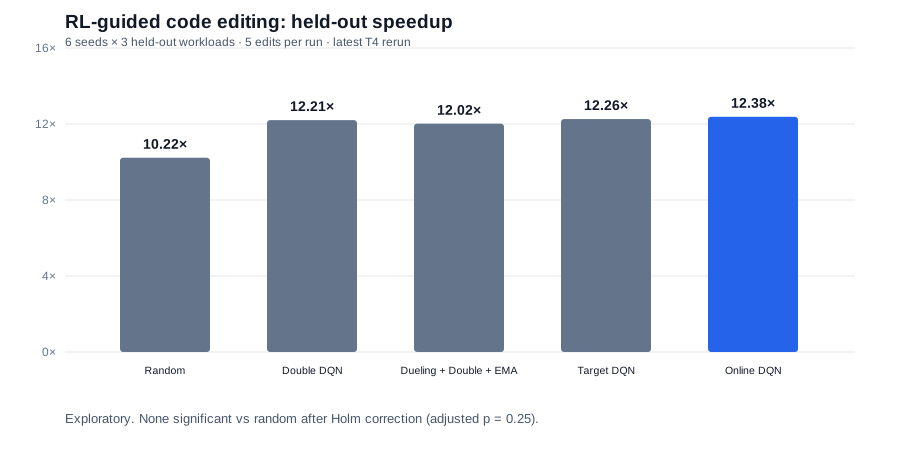
96/96 training-program checks and 72/72 held-out-program checks passed; 90 held-out policy outcomes from 6 random seeds, 3 held-out workloads, and 5 methods. Each network trained for 75 five-step episodes per seed.
| Method | Geometric held-out speedup from naive code | Paired Wilcoxon p vs random (Holm-adjusted) |
|---|---|---|
| Random edits | 10.224× | — |
| Online-only DQN | 12.377× | 0.2500 |
| DQN with hard target | 12.258× | 0.2500 |
| Double DQN with hard target | 12.205× | 0.2500 |
| Dueling Double DQN with soft target | 12.018× | 0.2500 |
Interpretation: The highest geometric held-out speedup in this repeat was from online-only DQN, not the dueling/Double/soft-update system, and none of the four RL comparisons to random is significant after correction. This experiment cannot identify which component causes any observed difference because the combined arm changes more than one factor. The very large absolute speedup mainly reflects replacing a deliberately inefficient broadcast implementation with a faster kernel family; it is not evidence of a new algorithm exceeding optimized libraries.
Results and claims
results/codelab_calibration.csv— real executable calibration configurations, timings, correctness.results/codelab_heldout_measurements.csv— held-out implementation correctness/timing.results/codelab_heldout_results.csv— every held-out seed, method, final code configuration, and reward.results/report.json— exact aggregated outcomes and multiple-comparison adjustment.- The notebook itself generates
/content/codelab_heldout.pngand/content/codelab_learning_curves.pngduring Colab execution.
Boundaries
This is not an LLM autonomously rewriting its code, a reproduction of Recursive’s Eureka Machine, or evidence for full recursive model self-improvement. The source-code edit family is hand-authored and finite; exhaustive calibration/profiling is possible; agents learn to select edits through cached benchmark feedback; no direct interaction with SWE-bench or frontier model training is claimed. Six seeds are underpowered, and runtime timing is noisy. More work is required to isolate target-update effects, train on genuinely unseen code tasks, and assess evaluator overfitting.
Research inspiration
DQN (Mnih et al.); Double DQN (van Hasselt et al.); Dueling DQN (Wang et al.); Darwin Gödel Machine (Zhang et al.); RRSI (Xia et al.).
License: experiment text and code offered for review and reproduction; no claim of scientific novelty.